
The Mysterious Day Time Itself Came Knocking at Rama’s Door
✍️ Rahasyawadi Varunanand Sansari (Mystic Varruna)
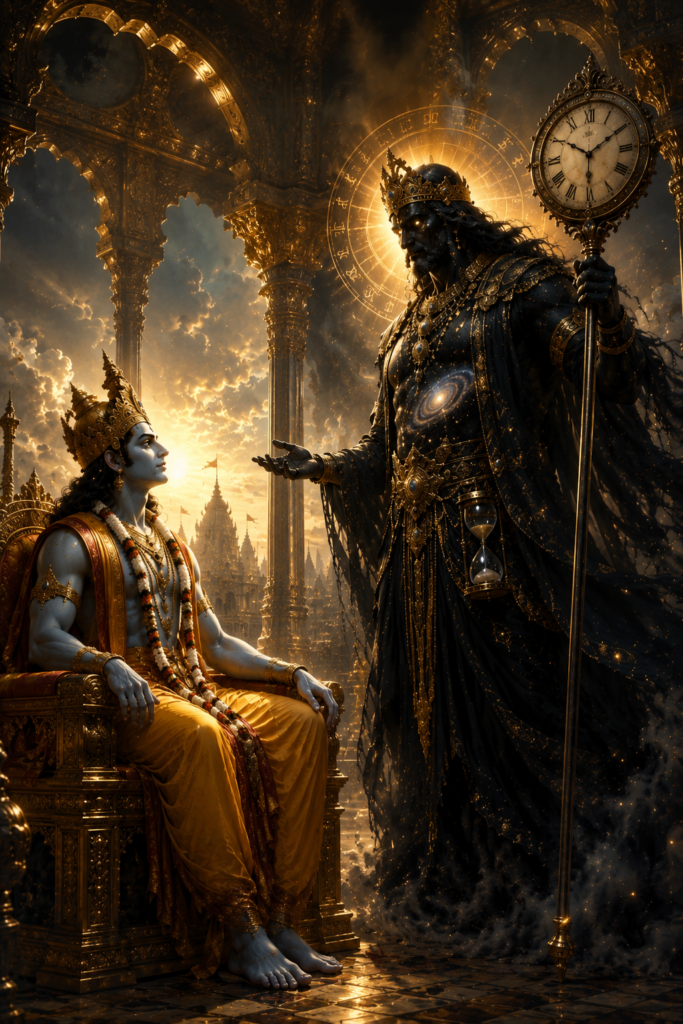
Eleven thousand years had passed since Shri Ram took the throne of Ayodhya. His rule was steeped in dharma — rains fell on time, the people were content, and all four brothers — Rama, Bharata, Lakshmana, Shatrughna — remained tirelessly devoted to the welfare of the world. No one could have imagined that on one such ordinary day, a visitor would arrive at the palace gate before whom even Time itself bows — because that visitor was Time itself, Kaal.
Time in the Guise of an Ascetic
That day, a radiant sage appeared at the royal gate. There was no anger in his eyes, no compassion either — only a vast, unmoving gravity. He said, “I must meet Raghava alone. This message is meant for his ears only.”
The gatekeeper carried word to Rama at once, and Rama invited the mysterious ascetic in. But just as he was about to enter, the sage laid down a strange condition: “O Rama, what we speak of must remain entirely secret. If anyone enters this chamber or overhears our words, you must have them put to death.”
Rama, the very embodiment of truth and his given word, agreed without a moment’s hesitation. He called Lakshmana and entrusted him with guarding the door — “Let no one enter, whatever may happen.” Lakshmana, honoring his elder brother’s command, took up his bow and stood immovable at the threshold.
The Message of Time
Inside the chamber, the ascetic revealed his true form — he was Kaal himself, carrying a message from Brahma. He said, “O Vishnu, you took human form to slay Ravana. Your appointed span of eleven thousand years upon this earth now draws to its close. If you wish, you may return to your abode in Vaikuntha — the gods await you there.”
Rama smiled and gave his silent assent. This was the moment — profound, bound to destiny — when Time itself came to remind the incarnation of God of the boundary of his mortal stay.
Durvasa’s Fury at the Gate
But destiny’s design was not yet complete. At that very moment, another radiant but famously short-tempered sage appeared at the royal gate — Durvasa himself. He demanded an immediate audience with Rama. Lakshmana said respectfully, “O sage, Raghava is occupied with a matter of great urgency. Please wait a while.”
Durvasa’s anger flared instantly. He warned, “If I am not brought before Rama this very moment, I shall curse the entire Raghu dynasty and all of Ayodhya to ashes!”
A terrible dilemma tore at Lakshmana’s heart. On one side stood the vow given to his elder brother — to break it meant his own death. On the other, the destruction looming over all of Ayodhya and the entire lineage. In an instant, Lakshmana made his decision — “If the price of my one life can save the whole city and the dynasty, then that is the better path.” He opened the door himself and went in to inform Rama of Durvasa’s arrival.
Between a Vow and a Brother’s Love
Rama came out at once and received Durvasa with full honor. The sage said he had just completed a thousand years of penance and wished to be fed. Rama served him food immediately, and Durvasa, satisfied, departed praising Rama.
But the moment this was over, Rama remembered the condition Kaal had set — and his heart filled with grief. Punishing his beloved brother seemed impossible, yet breaking his given word went against dharma itself. He summoned his ministers and his guru, Vasishtha.
Lakshmana himself consoled his brother — “This is merely the working of time, brother. Keep your word, and do not grieve for me. For the sake of both dharma and love, punish me without hesitation.”
On Vasishtha’s counsel, Rama found a middle path — since abandoning a righteous person was considered equivalent to death, he chose to banish Lakshmana rather than execute him. This decision let Rama honor both his given word and his brotherly love at once.
A Silent Farewell on the Banks of the Sarayu
Without a word of protest, Lakshmana went to the banks of the Sarayu river. There he stood with joined palms, settled into a yogic stillness, and consciously released his life-breath — freed from the body, he merged back into his true form, Sheshanaga, the great serpent upon whom Vishnu himself reclines.
This is the wondrous secret at the heart of this tale — Lakshmana was no ordinary man. He was the incarnation of Adishesha. When the time came, both he and Rama were destined to return, each to his own divine form.
The Deeper Philosophical Meaning
This episode is far more than a story — it is a profound symbol that even a divine incarnation is not beyond the bounds of time. When God himself takes human form on earth, he too becomes bound by the laws of time. This is the very pinnacle of keeping one’s word — that Rama was willing even to give up his own brother for it, because truth and dharma stand higher even than love.
Soon after, Rama too crowned Kusha and Lava as kings, and walked into the waters of the Sarayu himself — taking all the people of Ayodhya with him back to his abode in Vaikuntha. Thus the divine play that began with a single message from Time found its final, complete stillness in the waters of the Sarayu.
(Note for researchers: this episode is recounted in the Uttara Kanda of Valmiki’s Ramayana, chapters 103–110. Some later folk traditions identify this figure of “Kaal” with Yama instead — this distinction is not entirely clear in the original Sanskrit text, so both names appear side by side in popular tradition.)
Follow On Medium To Explore More About Ancient Hinduism 🕉️