
— The Devotion That Made God Walk to Her Door —
A Complete Research Article with References
By Mystic Varruna (Rahasyawadi Varunanand Sansari)
✦
In the vast tapestry of the Ramayana, among kings and sages and warriors, there lives one name that belongs to none of these categories — yet Lord Ram himself ate berries from her hands. That name is Shabri. A tribal woman, a forest-dweller, a soul consumed by waiting. Her story is not merely about devotion. It is proof that the Divine transcends caste, lineage, and social standing — and walks willingly to the door of the one who loves Him most.
Yet Shabri’s story is far deeper than the famous episode of the berries. Who were her parents? What was her previous birth? Why did she wait for decades? What was her bond with Sage Matanga? And what happened to her after Ram’s arrival? — This article answers all of these questions with textual references.
✦
① Shabri’s Birth — Her Lineage, Father, and Mother
Shabri was born into the Bhil tribe — a forest-dwelling community of ancient India that subsisted on hunting and forest produce. According to the Ramayana traditions and various Puranic sources, her father’s name was Shabara — and it is from this name that she came to be called Shabri. This patronymic naming convention was common in ancient India.
Spiritual commentators and traditional kathavachaks consistently describe Shabri’s father as a Bhil chieftain — the head of his clan, a man of relative wealth and social standing within his community. Her mother is not named in detail in primary texts, but traditional accounts describe her as an ordinary tribal woman.
Before her marriage could take place, a single event changed the course of Shabri’s life forever. As preparations for her wedding were underway, a large-scale animal sacrifice was being arranged. Shabri, struck by compassion for the helpless animals, refused to allow it. She left her home and walked into the forest — not in despair, but in search of something higher.
“She was born in a lowly clan — but her heart held a love that would make the Lord of the universe bow before her.”
Source: Valmiki Ramayana, Aranya Kanda; Adhyatma Ramayana, Kishkindha Kanda; Ramcharitmanas, Aranya Kanda (Tulsidas)
✦
② Shabri’s Previous Birth — Who Was She Before?
The question of Shabri’s past life is addressed across multiple Puranic and Ramayana traditions. Three major accounts exist:
First Account — According to the Skanda Purana and certain regional Puranic traditions, Shabri was in her previous birth a Yakshini or Apsara — a celestial being — who was cursed by a sage or deity for an act of disrespect or wrongdoing. As a consequence of this curse, she took birth in the mortal world in a tribal lineage. Yet the power of devotion transformed this curse into a vehicle for liberation.
Second Account — The Adhyatma Ramayana tradition holds that Shabri was, in a previous life, a deeply devoted woman whose spiritual journey remained incomplete. The unfinished thread of her bhakti needed to be completed — and so she was reborn in a tribal community, came under the shelter of Sage Matanga, and spent her entire life awaiting the moment her devotion would bear its ultimate fruit.
Third Account — A smaller stream of medieval commentators links Shabri to a Brahma-vadini — a woman seeker of Brahman knowledge — who, having pursued the path of jnana in a prior life, was reborn to experience the path of prema-bhakti, devotional love, and attain liberation through that route.
“The seed of devotion is indestructible — whether it takes one birth or many, it will bloom.”
Source: Adhyatma Ramayana, Kishkindha Kanda; Skanda Purana — Prabhasa Khanda; Ananda Ramayana
✦
③ Sage Matanga and Shabri’s Discipleship
When Shabri left her home and entered the forest, she eventually reached the hermitage of the great sage Matanga Rishi, situated near Pampa Lake in the Dandakaranya forest — a region corresponding to the present-day border areas of Karnataka and Andhra Pradesh.
In the beginning, the disciples of the ashram refused to admit Shabri — she was a tribal woman, an outsider. But Sage Matanga, who perceived the luminous quality of her inner devotion, not only welcomed her but accepted her as his disciple. She served the ashram with total selflessness for decades.
At the time of his mahaprayana (departure from the world), Matanga gave Shabri a promise: ‘Do not leave, my daughter. Remain here. Sri Ram will come to this forest. He will meet you. Your wait will not go in vain.’ This was the moment Shabri’s vigil began — and it would last for the rest of her mortal life.
“The word of the Guru is the life-breath of the disciple — Shabri made that word her only meditation.”
Source: Valmiki Ramayana, Aranya Kanda, Sarga 74; Ramcharitmanas, Aranya Kanda; Adhyatma Ramayana
✦
④ Why Did Shabri Wait for So Many Years?
This question reaches to the very heart of what Shabri’s story means. Her waiting was not mere patience — it was a living form of worship, sustained by absolute trust in her Guru’s word and absolute love for a God she had never seen.
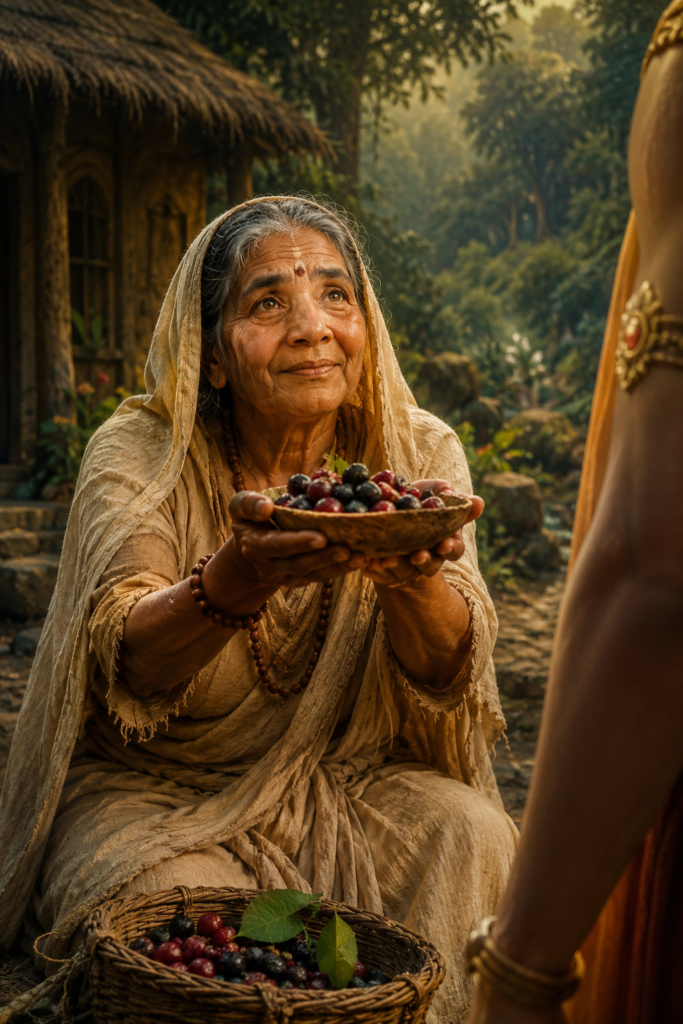
Every single morning after Matanga’s departure, Shabri would go to the banks of Pampa lake and gather berries from the forest. She would taste each berry with her own lips — and set aside only the sweet ones for Ram. The ones that were bitter, she discarded. This act of tasting — what tradition calls ‘juthe ber’ (pre-tasted berries) — was not a failure of decorum. It was the purest possible expression of love: ensuring that only the best would reach her beloved Lord.
Each day she swept the forest path, believing Ram might arrive that very day. Each day she arranged flowers and water. For years. For decades. Growing old in body, but never aging in faith. This form of longing — virah-bhakti, devotion through separation — is considered in Indian spirituality to be among the highest states a devotee can achieve.
“Waiting, when it is watered by love, becomes its own form of worship.”
Tulsidas renders this portrait with breathtaking beauty in the Ramcharitmanas — Shabri grew old waiting, her hair turned white, her body bent — but not a single day did her devotion waver.
Source: Ramcharitmanas, Aranya Kanda; Valmiki Ramayana, Aranya Kanda, Sarga 74; Adhyatma Ramayana
✦
⑤ The Meeting of Ram and Shabri — The Sacred Moment
Ram and Lakshmana were wandering through Dandakaranya in search of Sita. After liberating the demon Kabandha from his curse, it was Kabandha himself who directed Ram toward Pampa Lake and told him to seek out Shabri at Matanga’s ashram.
When Ram and Lakshmana arrived at the hermitage on the banks of Pampa, Shabri’s eyes filled with tears. She fell at Ram’s feet. She said — ‘Lord, I am a woman of low birth. I do not know the proper rituals of worship. I have nothing to offer you but these berries.’
Ram accepted those pre-tasted berries with love — and shared them with Lakshmana as well. This scene is perhaps the single most powerful symbol in all of Indian devotional literature. In that one act, every social barrier — of caste, purity, ritual correctness — dissolved entirely. The Lord of the Universe ate the humble offering of an old tribal woman, and found it sweeter than all the offerings of the learned.
“In love, the distinction between pure and impure ceases to exist — Ram proved this truth by eating Shabri’s berries.”
In the Valmiki Ramayana, this meeting is described with beautiful simplicity. Shabri also provides Ram with information about the surrounding region and possible directions for finding Sita — showing that she was not only a devotee but a wise and trusted guide.
In the Ramcharitmanas, Ram imparts to Shabri the teaching of Navadha Bhakti — the nine forms of devotion. This extraordinary teaching, which has shaped the entire devotional tradition of India, was not given to a king or a Brahmin scholar. It was given to an old tribal woman in a forest. This is the greatness of Sanatan Dharma.
Source: Valmiki Ramayana, Aranya Kanda, Sarga 74-75; Ramcharitmanas, Aranya Kanda, Doha ~34-35 section; Adhyatma Ramayana
✦
⑥ What Happened to Shabri After Ram’s Visit?
After Ram’s arrival, Shabri’s life-purpose was complete. The Guru’s word had proven true. The fruit of bhakti had been received. There was nothing left to wait for — because the One she had waited for was standing before her.
According to the Valmiki Ramayana, with Ram’s permission, Shabri entered the yogagni — the sacred fire of yoga — and departed from her mortal body. She immediately attained liberation. She assumed a divine form, clothed in celestial garments, and ascended to the higher realms.
“Sā citvā rāghavaṃ bhaktyā jvalitena’gninā tanum | jahau dehaṃ mahābhāgā viṣṇulokaṃ jagāma sā ||”
(Translation: That most blessed one, her heart filled with devotion to Raghava, cast off her body in the blazing fire and departed to Vishnuloka.)
In the Adhyatma Ramayana tradition, Shabri’s liberation is described as sayujya mukti — the highest form, where the soul merges with the Divine. The cycle of birth and death ended for her in that very moment.
In the Ramcharitmanas tradition, Tulsidas emphasises that Shabri’s moksha was immediate — no further births, no further waiting. The path of prema-bhakti, when consummated, delivers liberation with absolute finality.
Source: Valmiki Ramayana, Aranya Kanda, Sarga 75; Adhyatma Ramayana, Kishkindha Kanda; Ramcharitmanas, Aranya Kanda
✦
⑦ Shabri’s Spiritual Significance in Sanatan Philosophy
Shabri’s story is not merely a narrative from a scripture. It is a living declaration of Sanatan Dharma’s deepest principle: devotion belongs not to any caste, but to the heart.
In the Shankaracharya tradition, Shabri is cited as the supreme example of bhava-bhakti — devotion of pure inner feeling, untouched by ritual formality. In the Ramanuja tradition, she exemplifies prapatti — complete surrender to the Lord, with no intermediary required. In the Nimbarka tradition, she is the icon of prema-bhakti, devotional love.
The saints of medieval India — Kabir, Raidas, Mirabai — all referenced Shabri in their compositions. Kabir says: ‘Jo Ram ne Shabri ke ber khaye, wahi Ram mere man mein aaye’ — ‘The Ram who ate Shabri’s berries is the Ram who has entered my heart.’ This single line shows how deeply Shabri is embedded in the Indian spiritual imagination.
“Devotion has no caste, no lineage — Shabri proved this for all time.”
In modern times, Shabri is also honored as a symbol of pride for India’s tribal and indigenous communities. The Shabari River in Chhattisgarh and the Sabarimala pilgrimage tradition in Kerala both carry echoes of her memory into the present day.
✦
⑧ Major Sacred Sites Associated with Shabri
• Pampa Lake (Karnataka) — The site of Shabri’s ashram and her meeting with Ram. Considered one of the most sacred spots in Valmiki Ramayana geography.
• Shabridam (Gujarat, near Chhota Udaipur) — A significant regional pilgrimage site honouring Shabri’s legacy among tribal communities.
• Dandakaranya Region (Chhattisgarh-Odisha-Andhra border) — The vast forest in which Shabri spent her years of waiting.
• Matangavan — The forest area near Pampa associated with Matanga Rishi’s hermitage.
✦
📚 Reference Sources
1. Valmiki Ramayana — Aranya Kanda, Sarga 74-75 (Shabri episode)
2. Ramcharitmanas (Goswami Tulsidas) — Aranya Kanda
3. Adhyatma Ramayana — Kishkindha Kanda
4. Ananda Ramayana — Sara Kanda
5. Skanda Purana — Prabhasa Khanda
6. Kamba Ramayana (Tamil) — Aranya Kanda
7. Srimad Bhagavata Purana — Bhakti-vivechana sections
8. Vinaya Patrika (Tulsidas) — Shabri-stuti
9. Sant Kabir Vani — Padas referencing Shabri
10. Dr. Ram Vilas Sharma — ‘Ramayana ki Bhumika’ (Shabri analysis)
11. Swami Vivekananda — ‘Bhakti Yoga’ (Shabri cited as example of supreme devotion)
✦
Conclusion
Shabri’s story reminds us that the attainment of God does not require high birth, great learning, or material wealth. It requires only one thing — sincere, unconditional love. Shabri had nothing else, and nothing else was needed.
Whenever a devotee gives their entire life to waiting for their Beloved, Shabri’s soul lives on in that devotee. And whenever God accepts the humble, imperfect offering of a loving heart, the universe bows to that sacred moment.
“Jai Siya Ram — Jai Shabri Mai.”
✦ Author: Rahasyawadi Varunanand Sansari | Mystic Varruna Channel ✦
Varuna Sanatan Siksha Foundation, Kanpur, Uttar Pradesh
YouTube: Mystic Varruna | Global Hinduismm | Mystic Bhajan | VarrunaNGO