
Introduction
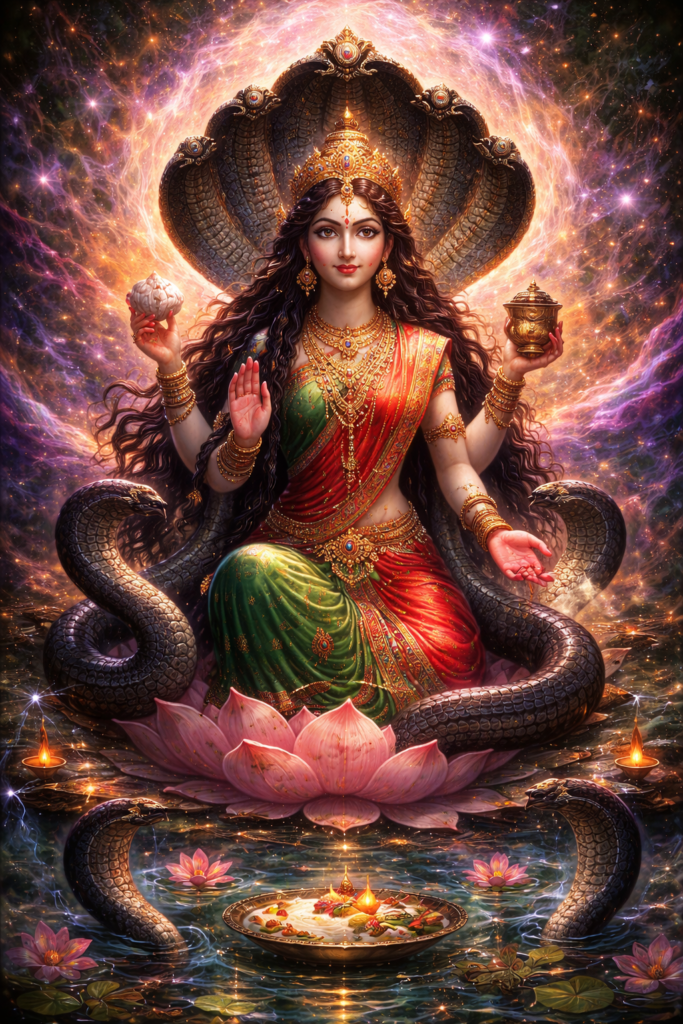
Across the eastern lands of Bharat—especially Bengal, Assam, and parts of Odisha—there lives a deeply emotional and mystical tradition devoted to a goddess who embodies both fear and protection. She is the serpent goddess Manasa, worshipped as the protector from snake bites, the giver of fertility, and the guardian of rural life.
Unlike many widely celebrated deities of Hindu tradition, the story of Manasa Mata is filled with pain, rejection, struggle, and ultimate acceptance. Her mythology is not just about divine power—it is about a goddess fighting for recognition and devotion in a world that initially denied her place among the gods.
Her origin is one of the most emotionally intense narratives in Hindu mythology.
The Mysterious Birth of Manasa
The origins of Manasa Mata are described in several texts and regional traditions, particularly in the Devi Bhagavata Purana, the Brahma Vaivarta Purana, and the famous Bengali literary work Manasamangal.
According to mythology, Manasa is considered the daughter of Shiva.
However, unlike other divine children, her birth did not bring joy to heaven.
Some traditions say she emerged from Shiva’s mind, while others describe her as being born from Shiva’s seed that fell upon the earth and was nurtured by serpents. Because of this mysterious birth, Manasa became associated deeply with the world of nagas (serpents).
She was raised among the serpent clans and later became known as the sister of Vasuki, the great serpent king.
Yet, despite her divine lineage, Manasa faced something devastating.
She was rejected by the very world she belonged to.
The Pain of Rejection
The greatest emotional depth of Manasa’s story lies in her struggle for recognition and acceptance.
According to several traditions, Parvati, the wife of Shiva, did not accept Manasa as part of the divine family. In some stories, Parvati even caused Manasa to lose one of her eyes in anger.
Because of this, Manasa is often depicted as a one-eyed goddess.
Imagine the loneliness of a divine being born from a god, yet denied a place among the gods.
She existed between worlds:
not fully accepted in heaven yet deeply powerful on earth
This rejection shaped the goddess into a force that demanded devotion—not out of pride, but out of a longing to be acknowledged.
Manasa and the Power of Serpents
Manasa became the goddess of snakes, controlling the venomous forces of nature.
In ancient India, snakes represented both death and divine power. A snake bite could end a life within minutes, especially in rural areas.
Thus, the worship of Manasa developed as a way to seek protection from the terrifying power of serpents.
She became the protector of villages, farmers, and travelers, ensuring that those who honored her would remain safe from snake attacks.
Her iconography reflects this power:
she is often shown surrounded by snakes a serpent hood spreads above her head like a divine crown she sits calmly, controlling creatures that symbolize death itself
But her story becomes far more intense with the legend of Chand Saudagar.
The Conflict with Chand Saudagar
One of the most dramatic episodes in Manasa’s mythology comes from Manasamangal, a medieval Bengali narrative poem.
The story revolves around a wealthy merchant named Chand Saudagar.
Chand Saudagar was a devoted worshipper of Shiva and refused to worship Manasa.
For the goddess who had already experienced rejection, this refusal became a personal wound.
Manasa demanded that Chand Saudagar acknowledge her divinity.
But he refused again and again.
And thus began one of the most emotionally powerful confrontations between a human and a goddess.
The Tragedy of the Seven Sons
To compel Chand Saudagar to accept her worship, Manasa unleashed a devastating punishment.
One by one, his seven sons were killed by snake bites.
Imagine the grief of a father watching each child die.
Yet even after this unimaginable loss, Chand Saudagar refused to bow to Manasa.
His devotion to Shiva was absolute.
The story reveals something profound about Hindu mythology:
Even gods and goddesses must struggle for devotion.
Divinity itself sometimes demands recognition.
The Story of Behula
The emotional climax of the Manasa legend arrives through the character Behula, the wife of Chand Saudagar’s youngest son Lakhindar.
On the night of their wedding, Manasa sent a serpent to kill Lakhindar.
But Behula refused to accept her husband’s death.
She placed his lifeless body on a raft and began a long journey across the river, praying to the gods.
For days she drifted, singing prayers and performing acts of devotion.
Her love and determination moved the heavens.
Finally, the gods intervened.
They asked Manasa to show compassion.
And the goddess agreed—on one condition.
Chand Saudagar must finally worship her.
At last, after so much loss and suffering, Chand Saudagar reluctantly offered flowers to Manasa.
With that single act of recognition, Manasa revived the dead sons.
The conflict ended.
But the emotional scars remained.
Symbolism of the Story
The story of Manasa is deeply symbolic.
It reflects several themes:
1. The struggle for recognition
Manasa represents forces of nature that were once feared but later respected.
2. The balance between devotion and pride
Chand Saudagar’s refusal shows how devotion to one deity can sometimes lead to conflict with another.
3. The power of human love
Behula’s journey is one of the most moving love stories in Indian mythology.
Her devotion literally changed the will of the gods.
Worship of Manasa Mata
Today, Manasa Mata is widely worshipped in eastern India.
Her festivals are especially prominent during the monsoon months, when snake activity increases.
Devotees offer:
milk flowers clay serpent idols traditional songs and rituals
In many villages, her shrines stand beneath trees or near rivers.
The worship is deeply connected with rural life and survival.
For farmers and villagers, Manasa is not just a goddess.
She is the protector who stands between life and death.
References in Scriptures and Literature
The mythology of Manasa appears in several important sources:
Devi Bhagavata Purana Brahma Vaivarta Purana Manasamangal (Bengali medieval literature)
Among these, Manasamangal provides the most detailed narrative of the conflict between Manasa and Chand Saudagar.
Conclusion
The story of Manasa Mata is unlike many divine legends.
It is not merely about power or miracles.
It is about pain, rejection, persistence, and eventual acceptance.
She is a goddess born from divine origin yet forced to fight for recognition.
Her mythology reminds us that even the divine realm reflects the complex emotions of existence:
longing pride grief devotion forgiveness
In the end, Manasa’s victory is not simply over Chand Saudagar.
It is the victory of acknowledgment over denial, and reverence over fear.
And perhaps that is why, centuries later, people still whisper her name when they see a serpent in the fields.
Because somewhere in the quiet corners of rural India, the serpent goddess still watches.
And those who remember her remain under her protection.