
Holi is not merely a festival of colors; it is one of the most ancient celebrations of human civilization, deeply rooted in the spiritual and cultural traditions of Sanatan Dharma. Celebrated across India and in many parts of the world, Holi symbolizes the triumph of faith over tyranny, devotion over arrogance, and light over darkness. Its origins go back to the ancient story of Prahlad and Holika, a narrative preserved in the Puranas and remembered every year through the ritual of Holika Dahan.
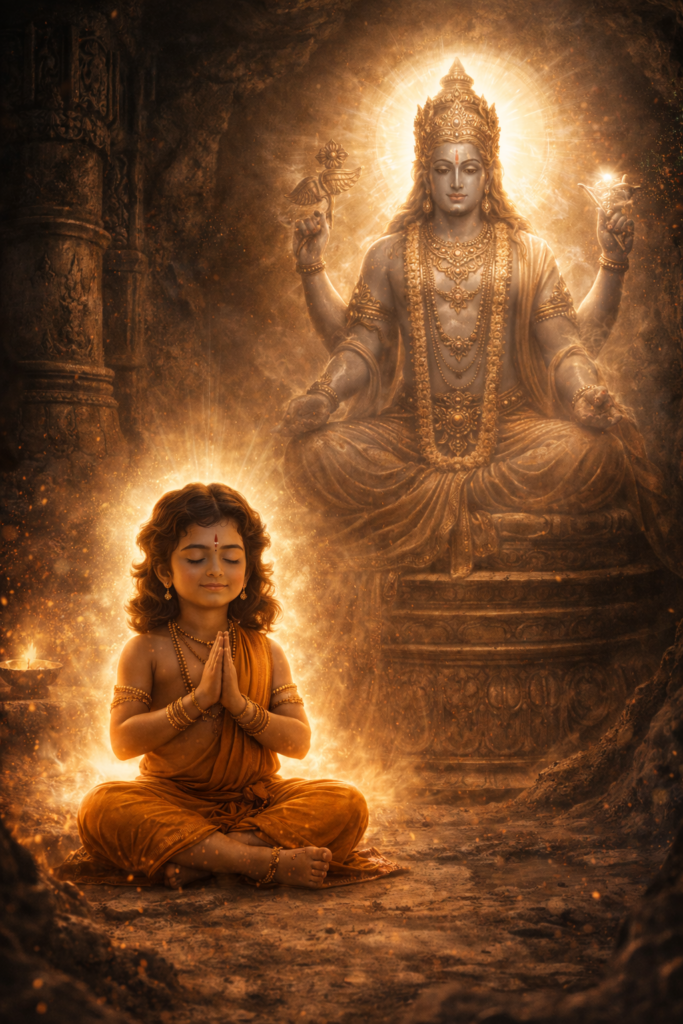
The festival carries echoes of Satya Yuga, the first age of the cosmic cycle, when the story of Prahlad unfolded and set the foundation for a tradition that has continued for thousands of years.
The Story of Prahlad: The Beginning of Holi
The roots of Holi lie in the story described in texts such as the Bhagavata Purana (Skanda 7), Vishnu Purana, and Narada Purana. These texts narrate the story of Prahlad, the devoted son of the powerful demon king Hiranyakashipu.
Hiranyakashipu was one of the most formidable Asura kings mentioned in Hindu scriptures. Through intense penance to Lord Brahma, he obtained a powerful boon that made him nearly invincible. He could not be killed by man or beast, inside or outside, during day or night, on earth or in the sky, or by any weapon.
Empowered by this boon, Hiranyakashipu became arrogant and declared himself a god. He demanded that everyone in his kingdom worship him instead of Lord Vishnu.
However, his own son Prahlad refused.
Prahlad was a devotee of Lord Vishnu from childhood. Even when taught by teachers loyal to his father, Prahlad constantly spoke about devotion to Vishnu and the importance of righteousness.
Hiranyakashipu saw this as rebellion.
The Attempts to Kill Prahlad
Enraged by his son’s devotion, Hiranyakashipu attempted several times to kill Prahlad. According to the Bhagavata Purana, Prahlad was:
Thrown from a mountain Trampled by elephants Poisoned Attacked by snakes Cast into fire
But each time, Prahlad survived due to his unwavering devotion to Vishnu.
The final and most famous attempt involved Hiranyakashipu’s sister Holika.
Holika had a magical boon that made her immune to fire. Hiranyakashipu ordered her to sit in a blazing fire with Prahlad in her lap so that Prahlad would burn to death.
However, according to the Puranas, Holika’s boon worked only if she entered fire alone. Because she misused it for evil, the protection failed.
Prahlad, protected by divine grace, survived the fire, while Holika was burned to ashes.
The First Holika Dahan
This moment became symbolic.
The burning of Holika represented the destruction of arrogance, cruelty, and misuse of power. Prahlad’s survival represented the victory of devotion and righteousness.
Since then, people began lighting bonfires to commemorate this event.
This ritual came to be known as Holika Dahan, which is still performed on the night before Holi.
In villages across India, people gather wood, create a symbolic pyre, and burn it while chanting prayers and celebrating the triumph of good over evil.
The Appearance of Narasimha
Soon after Holika’s death, the story reaches its climax.
Hiranyakashipu challenged Prahlad, asking where Vishnu was. Prahlad replied that Vishnu is everywhere.
In anger, Hiranyakashipu struck a pillar.
From that pillar emerged Narasimha, the half-man half-lion avatar of Vishnu.
Narasimha killed Hiranyakashipu in a way that fulfilled every condition of the boon:
At twilight (neither day nor night) On a palace threshold (neither inside nor outside) On his lap (neither earth nor sky) Using claws (not a weapon)
This story symbolizes cosmic justice.
The narrative is preserved in the Bhagavata Purana (7.8) and Vishnu Purana (Book 1).
From Fire to Colors
Originally, Holi was mainly associated with Holika Dahan, the bonfire ritual.
But over time, another dimension emerged: the celebration of colors.
Many scholars believe the color celebration became popular during the Dwapara Yuga, especially through the legends of Lord Krishna in Vrindavan.
According to tradition, Krishna would play with colors and water with Radha and the Gopis. This playful celebration symbolized love, joy, and divine play.
The tradition of throwing colors (gulal) during Holi is believed to have originated from these Krishna legends.
Texts like the Harivamsa and regional folklore of Braj mention these playful celebrations.
Holi in Ancient India
Historical evidence shows that Holi has been celebrated for thousands of years.
The festival is mentioned in ancient Sanskrit texts such as:
Jaimini’s Purva Mimamsa Sutra Kathaka Grhya Sutra Narada Purana Bhavishya Purana
The Bhavishya Purana describes Holi as a festival celebrated at the arrival of spring.
Ancient temple sculptures and paintings also depict people playing with colored powders.
For example:
Murals in Vijayanagara temples Paintings from the Mewar school Mughal-era miniature paintings
These artworks show kings and queens celebrating Holi with colors and music.
Even Mughal emperors like Akbar and Jahangir are recorded in historical texts as participating in Holi celebrations.
Holi as a Spring Festival
Another reason Holi became popular is its connection with Vasant Ritu (spring season).
Spring marks the end of winter and the beginning of agricultural prosperity.
In ancient agrarian societies, festivals were often linked to seasonal cycles.
Holi thus became a celebration of:
Fertility Harvest Renewal of life
Farmers celebrated the coming harvest, while communities celebrated the renewal of nature.
Regional Traditions of Holi
Across India, Holi developed many unique regional traditions.
Lathmar Holi (Barsana and Nandgaon)
In Barsana, the birthplace of Radha, women playfully hit men with sticks while men defend themselves with shields.
This reenacts Krishna teasing Radha and her friends.
Phoolon Ki Holi (Vrindavan)
Instead of colors, priests and devotees throw flowers in temples like Banke Bihari Temple.
Royal Holi (Rajasthan)
In Rajasthan, Holi is celebrated with royal processions, elephants, and traditional music.
Hola Mohalla (Punjab)
Among Sikhs, the festival takes the form of Hola Mohalla, started by Guru Gobind Singh. It includes martial arts displays and community gatherings.
Spiritual Meaning of Holi
Beyond colors and celebration, Holi carries deep spiritual symbolism.
1. Victory of Good Over Evil
The story of Prahlad reminds people that faith and righteousness ultimately triumph over tyranny.
2. Burning of Ego
Holika symbolizes arrogance and misuse of power.
Holika Dahan represents the burning of ego and negativity.
3. Equality and Unity
During Holi, social barriers temporarily dissolve.
People from all backgrounds celebrate together.
4. Joy of Life
Colors symbolize the diversity and beauty of life itself.
Holi in the Modern World
Today Holi is celebrated not only in India but across the world.
Countries like:
Nepal Mauritius Fiji Trinidad United States United Kingdom
host large Holi celebrations.
The festival has become a global symbol of joy and cultural heritage.
Universities, cultural organizations, and Indian diaspora communities celebrate Holi with music, dance, and color festivals.
Holi and the Continuity of Civilization
One of the most remarkable aspects of Holi is its continuity.
Few festivals in the world have been celebrated continuously for thousands of years.
From the ancient story of Prahlad in Satya Yuga to the playful colors of Vrindavan, Holi reflects the evolving yet enduring spirit of Indian civilization.
The fire of Holika still burns every year, reminding humanity that faith, truth, and devotion will always prevail.
And the colors of Holi remind us that life, despite its struggles, is meant to be celebrated.
Conclusion
Holi is far more than a festival of colors.
It is a living memory of one of the oldest spiritual stories in human civilization — the story of Prahlad’s devotion and the triumph of good over evil.
From Satya Yuga to the modern world, Holi has carried forward a timeless message:
No matter how powerful darkness appears, the light of truth and devotion will always prevail.
As people gather around the Holika fire and later play with colors, they unknowingly continue a tradition that began thousands of years ago — a celebration of faith, resilience, and the eternal joy of life.