
A Journey from the Ramayana to the Modern Era
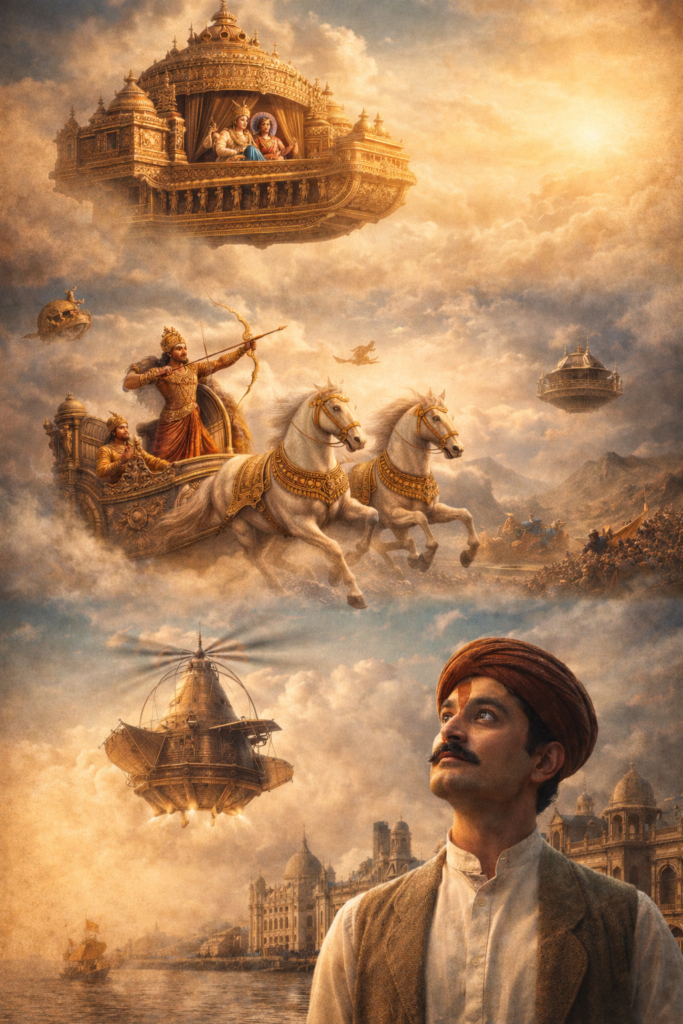
The desire to fly in the sky is extremely ancient in human civilization. Today, modern aviation technology has made the world smaller, but when we look at Indian scriptures and traditions, it appears that the idea of flying in the sky existed in India thousands of years ago.
Ancient texts such as the Ramayana and the Mahabharata mention “Vimanas,” which suggests that Indian sages had imagined flying machines long before modern aviation.
The question, however, is still debated today:
Did ancient India really build aircraft, or were these descriptions symbolic?
Let us try to understand this topic through the perspectives of the Ramayana, Mahabharata, and the modern era.
The Mention of Aircraft in the Ramayana
In Indian tradition, the most famous reference to a flying vehicle appears in the Ramayana. According to the epic, the king of Lanka, Ravana, possessed a magnificent flying vehicle known as the Pushpaka Vimana.
What Was the Pushpaka Vimana?
In the Valmiki Ramayana, the Pushpaka Vimana is described as a divine chariot capable of flying through the sky. It originally belonged to Kubera, the god of wealth, but Ravana took it from him.
According to the Ramayana, this Vimana:
Could fly through the sky Could travel at great speed Could carry many passengers at once Could change direction according to the will of the traveler
After defeating Ravana, Lord Rama, Sita, and Lakshmana returned to Ayodhya using this Pushpaka Vimana.
The text also describes the Vimana as a self-moving vehicle that could expand in size depending on the number of passengers. Because of these descriptions, some people compare it to modern aircraft or spacecraft.
Was the Pushpaka Vimana a Mechanical Aircraft?
The Ramayana provides detailed descriptions of the Vimana, but it is not entirely clear whether it was a mechanical machine or a divine vehicle powered by supernatural forces.
Some scholars believe:
It may hint at advanced technology Or it could simply be symbolic storytelling
Nevertheless, it is remarkable that a text written thousands of years ago contains the idea of a flying vehicle.
Flying Vehicles in the Mahabharata
After the Ramayana, references to aerial vehicles also appear in the Mahabharata.
The epic mentions divine chariots, celestial vehicles, and flying machines used by gods and warriors.
Arjuna’s Journey to Heaven
According to the Mahabharata, when Arjuna traveled to heaven, he went there in the divine chariot of Indra, moving through the sky.
This chariot:
Could travel through the sky Moved at great speed Was operated by divine forces
Some scholars consider this another example of aerial vehicle descriptions in ancient Indian literature.
Aerial Warfare in the Mahabharata
The Mahabharata also contains descriptions of battles taking place in the sky.
Some researchers interpret these passages as early imaginations of aerial combat, though it is not certain whether they describe real technology or mythological storytelling.
The Vaimanika Shastra and Ancient Aircraft
In the 20th century, a text called the Vaimanika Shastra gained attention. It is traditionally associated with the sage Maharshi Bharadwaj.
This text allegedly describes different types of aircraft such as:
Rukma Vimana Shakuna Vimana Sundara Vimana
It also discusses materials, structure, and methods of operating flying machines.
However, modern scientific studies have suggested that the technologies described in this text are not practically feasible.
Still, the text shows that ancient Indian thinkers were deeply interested in the concept of flying machines.
Did Ancient India Really Have Aircraft?
Scholars hold different opinions on this matter.
The Supporters’ View
Some people believe that:
Ancient India had advanced scientific knowledge Aircraft technology might have existed That knowledge may have been lost over time
They point to references in the Ramayana, Mahabharata, and Vaimanika Shastra as evidence.
The Scientific View
Most modern scientists argue that:
No archaeological evidence has been found There is no proof that mechanical aircraft existed in ancient India
According to them, the Vimanas described in ancient texts are likely symbolic or mythological.
Aircraft in the Modern Era
In modern history, the invention of the airplane is generally credited to the Wright Brothers, who successfully flew the first controlled powered aircraft in 1903.
After that, aviation technology developed rapidly.
Today’s aircraft can:
Travel thousands of kilometers Carry hundreds of passengers Even fly faster than the speed of sound
Humans have also developed rockets and spacecraft capable of traveling beyond Earth.
Indian Experiments Before the Wright Brothers
Interestingly, some claims suggest that aviation experiments may have been attempted in India even before the Wright Brothers.
In the late 19th century, an Indian scholar from Mumbai named Shivkar Bapuji Talpade reportedly built a flying machine.
It is said that in 1895, he tested his aircraft at Chowpatty Beach in Mumbai.
The aircraft was called “Marutsakha”, which means “Friend of the Wind.”
According to some accounts, Talpade was inspired by ancient Indian texts such as the Vaimanika Shastra.
Some narratives claim that his machine briefly flew during the demonstration.
However, there is very limited scientific evidence supporting this event, so historians do not consider it a confirmed powered flight.
Still, it remains an interesting part of India’s aviation history.
From Ancient Imagination to Modern Science
When we compare ancient scriptures with modern science, an interesting pattern appears.
Ancient Indian thinkers imagined flying vehicles and described them in their texts.
Thousands of years later, modern science turned that imagination into reality.
This shows how powerful human imagination can be in shaping future scientific progress.
The Concept of Vimanas in Indian Culture
In Indian culture, the word Vimana was not always meant to describe a mechanical machine.
Often it symbolized:
Divine power Heavenly travel Vehicles of gods
Therefore, the descriptions of Vimanas should also be understood within their religious and cultural context, not only through modern technological interpretation.
Conclusion
Ancient Indian texts like the Ramayana and Mahabharata clearly mention flying vehicles. The description of the Pushpaka Vimana suggests that the concept of aerial travel existed in Indian thought thousands of years ago.
However, modern science has not yet found concrete evidence proving that mechanical aircraft were actually built in ancient India.
Still, the detailed descriptions of flying vehicles in ancient scriptures are fascinating and show the depth of imagination in early Indian civilization.
They remind us that humanity’s dream of flying is extremely ancient.
And perhaps those ancient dreams eventually inspired the scientific advancements that allow humans to fly today.
A Message From the Author
If this article touched your heart,
you can stand with me in this small effort.
I am working alone, within my capacity,
to rediscover forgotten temples, traditions,
and the deeper knowledge of Sanatan Dharma.
This journey is not only about words —
it is about dedication, research, and continuous effort.
If you feel this work is meaningful,
even a small contribution from you
can become a drop of oil that keeps this lamp burning.
Your support will not just be financial help —
it will be your participation in reviving the heritage of Sanatan culture.
If your heart allows,
please hold my hand in this journey.
Even a small contribution
can help keep this flame alive. 🙏
UPI / PhonePe: 9639902892