
Among the many deities mentioned in the ancient scriptures of Hinduism, Brihaspati holds a unique and profound place. He is known as the Guru of the Devas, the divine teacher who guides the gods with wisdom, knowledge, and righteousness. In Hindu tradition, the day Thursday (गुरुवार) is dedicated to him, and in Vedic astrology (Jyotisha) he is identified with the planet Jupiter, called Guru.
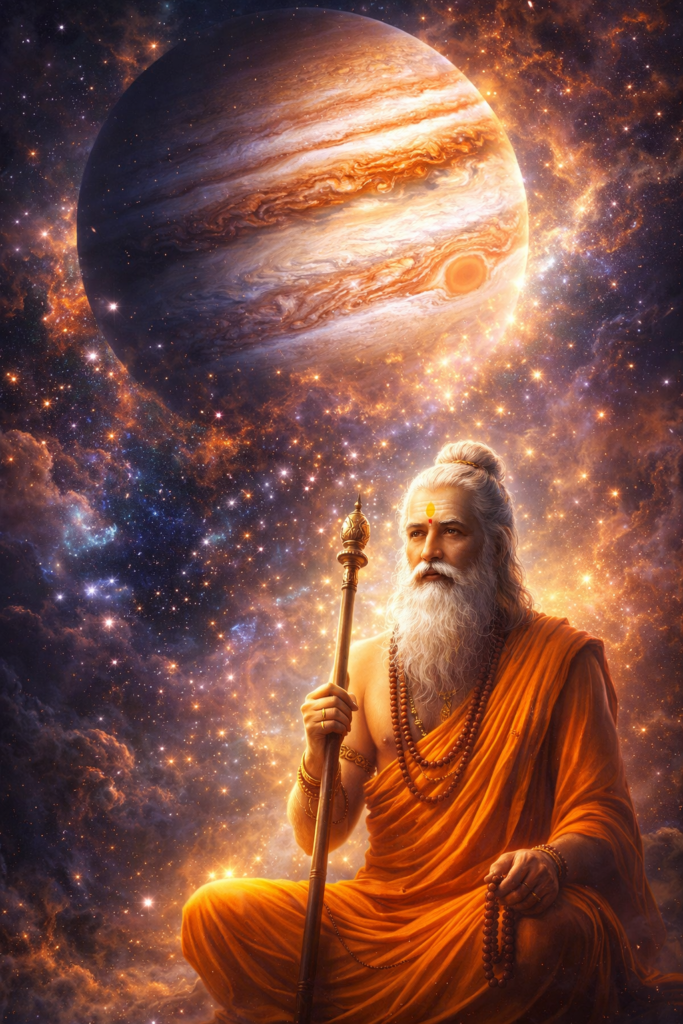
This connection between a celestial body and a divine teacher reveals something remarkable about the worldview of ancient Indian sages. To them, the universe was not merely a collection of stars and planets—it was a living, conscious order where cosmic forces influenced life on Earth.
Origins of Brihaspati in the Vedic Age
The earliest references to Brihaspati appear in the Rigveda, one of the most ancient sacred texts known to humanity. In the Rigveda, Brihaspati is described as a powerful deity associated with speech, sacred knowledge, and divine wisdom.
The hymns portray him as:
The lord of sacred prayers and mantras The protector of sacred knowledge The guide and counselor of the gods
In many Vedic verses, Brihaspati is invoked as a force that breaks open the barriers of ignorance and reveals truth. His power is not physical strength but spiritual authority and wisdom.
Because of this role, Brihaspati became known as “Guru”, the supreme teacher.
Brihaspati — The Guru of the Gods
In later Hindu literature such as the Puranas, Brihaspati is described as the teacher of the Devas (celestial beings).
Whenever the gods faced confusion or moral dilemmas, they turned to Brihaspati for guidance. He instructed them in:
Dharma (righteous conduct) Spiritual discipline Sacred rituals Cosmic law
In many stories, even powerful gods like Indra seek Brihaspati’s counsel.
This emphasizes an important idea in Hindu philosophy: knowledge is greater than power. Even kings of heaven require the guidance of wisdom.
The Connection Between Brihaspati and Jupiter
In Vedic astrology, each planet represents a cosmic force that influences human life. The planet Jupiter is associated with Brihaspati and is therefore called Guru.
Jupiter is the largest planet in the solar system, and its gravitational influence plays a crucial role in maintaining stability in the planetary system. Modern astronomy shows that Jupiter acts almost like a cosmic protector, attracting or deflecting many comets and asteroids that might otherwise strike inner planets such as Earth.
Ancient Indian sages, observing the sky for centuries, noticed Jupiter’s slow and majestic movement across the heavens. Unlike the faster-moving planets, Jupiter takes about 12 years to complete one orbit through the zodiac.
Because of its size, brightness, and steady motion, Jupiter was regarded as a symbol of wisdom, expansion, and benevolent influence.
Thus the sages connected this planet with the divine teacher—Brihaspati.
Thursday — The Day of Guru
The association between Brihaspati and Jupiter also gave rise to the tradition of Thursday worship.
In Sanskrit, Thursday is called Brihaspativar or Guruvar.
Devotees often:
Wear yellow clothes Offer yellow foods like turmeric, gram, and bananas Recite prayers dedicated to Brihaspati Seek blessings for knowledge and prosperity
Yellow is associated with Jupiter because it symbolizes wisdom, learning, and spiritual clarity.
Brihaspati in Hindu Cosmology
In the philosophical worldview of ancient India, planets were not merely physical bodies but manifestations of cosmic intelligence.
The Navagraha system describes nine planetary forces that influence the universe and human destiny.
Among them, Brihaspati represents:
Wisdom Dharma Expansion Prosperity Spiritual knowledge
A strong Jupiter in astrology is believed to bring learning, good fortune, and moral guidance.
The Mystery Behind the Guru Planet
Why did the ancient sages connect Jupiter with wisdom and guidance?
Some researchers believe that this association may reflect a deep intuitive understanding of the planet’s role in the solar system.
Jupiter’s enormous gravitational field helps stabilize the planetary system. In a way, it acts as a guardian planet, influencing the paths of comets and asteroids.
In symbolic terms, this protective role mirrors the role of Brihaspati—the guide who protects the cosmic order through wisdom.
Whether this connection was purely symbolic or based on deeper astronomical observations remains a fascinating mystery.
The Timeless Symbol of Wisdom
Today, Brihaspati continues to represent the highest ideals of knowledge and spiritual guidance.
In Hindu philosophy, a Guru is not merely a teacher but a light that dispels darkness. The word itself is often interpreted as:
Gu — darkness Ru — remover
Thus the Guru is the remover of ignorance.
By associating this concept with the majestic planet Jupiter, the sages created a powerful symbol linking cosmic order with spiritual wisdom.
Conclusion
The story of Brihaspati reveals the profound way in which ancient Indian thinkers understood the universe. They saw the cosmos not as a lifeless mechanism but as a harmonious system where celestial bodies reflected deeper spiritual truths.
By identifying Jupiter with the divine teacher Brihaspati, they expressed an idea that remains timeless: wisdom is the guiding force of the universe.
Even today, when people observe Thursday as the day of Guru, they are participating in a tradition that stretches back thousands of years—a tradition that connects human knowledge with the vast mysteries of the cosmos.