
Among the many deities mentioned in the ancient Vedic scriptures of Hinduism, several once held great importance but gradually faded from popular worship. One such deity is Pushan, a fascinating yet largely forgotten god described in the Rigveda. In early Vedic religion, Pushan was revered as the protector of travelers, guide of paths, guardian of cattle, and provider of prosperity. However, over time his prominence declined as religious traditions evolved and other deities became central to Hindu worship.
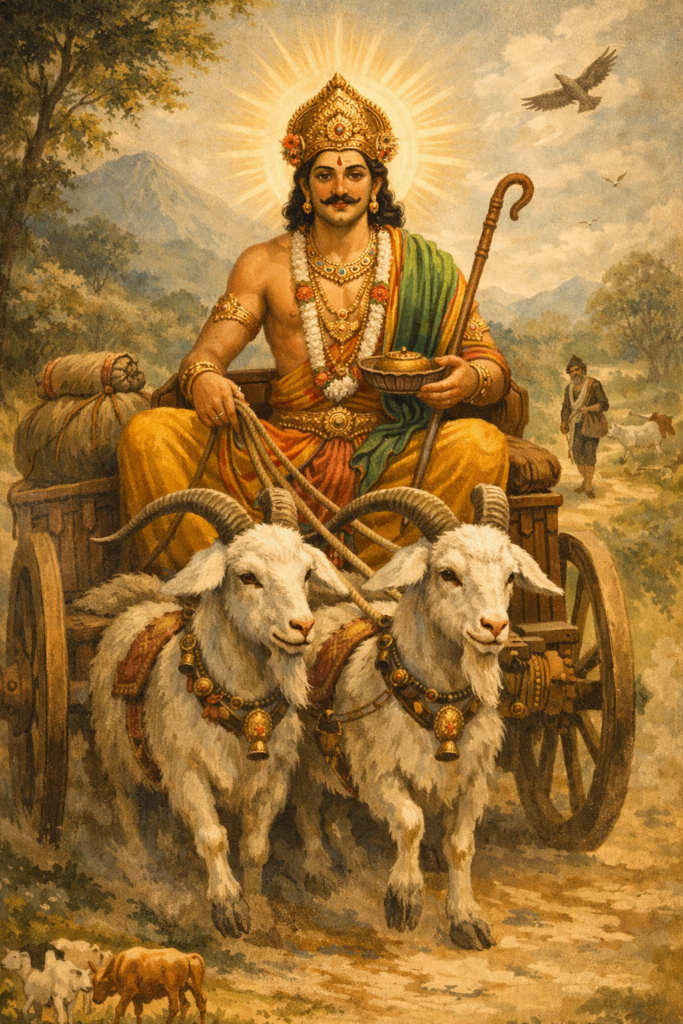
The story of Pushan offers an important glimpse into the transformation of ancient Vedic religion into the later forms of Hinduism that are widely practiced today.
1. Origins of Pushan in the Vedic Age
Pushan appears primarily in the Rigveda, the oldest surviving sacred text of the Indo-Aryan civilization, composed roughly between 1500–1200 BCE. In the hymns of this ancient scripture, Pushan is described as a benevolent and protective deity closely connected with travel, agriculture, and pastoral life.
Unlike many Vedic gods associated with cosmic forces such as storms, fire, or the sun, Pushan had a more practical and everyday role in human life. He was considered a divine guide who ensured that travelers reached their destination safely and that herdsmen could find their cattle.
In the Rigveda, Pushan is often invoked for:
Safe journeys Finding lost animals Protection on unknown roads Prosperity for farmers and herdsmen Guidance through dangerous territories
Ancient communities depended heavily on cattle and long journeys through forests or deserts. In such a world, the idea of a divine protector of roads and paths held enormous importance.
Pushan was therefore not just a symbolic deity; he represented security, guidance, and survival in an uncertain world.
2. Pushan’s Role as the Divine Guide
One of the most distinctive aspects of Pushan is his role as a guide. Vedic hymns frequently ask him to show the right path and lead people safely through unknown regions.
In this sense, Pushan can be seen as a spiritual navigator. His protection extended beyond physical travel. Some Vedic verses describe him guiding souls of the dead to the afterlife.
Because of this role, Pushan was associated with transition and movement—not only journeys on earth but also the passage from life to death.
He is sometimes described as:
The knower of roads The finder of lost things The guardian of travelers The guide of souls
This dual function made Pushan both a protector in the material world and a spiritual guide in the cosmic order.
3. Appearance and Symbolism
The descriptions of Pushan in Vedic texts are unique and sometimes unusual compared to other gods.
One of the most distinctive features is that Pushan is said to ride a chariot drawn by goats instead of horses. This imagery reflects his connection with pastoral life and rural communities.
Other symbolic elements associated with Pushan include:
A staff or shepherd’s stick, symbolizing guidance Goats, representing fertility and pastoral life Roads and paths, symbolizing movement and exploration
Another curious detail in later mythology is that Pushan is sometimes described as toothless, surviving on soft food such as porridge. Scholars believe this strange feature comes from a myth involving Shiva and the famous Daksha Yajna, where Pushan’s teeth were allegedly broken during the destruction of the sacrifice.
Whether symbolic or mythological, these features give Pushan a distinct personality among the Vedic gods.
4. Pushan in the Rigveda
Pushan is mentioned in several hymns of the Rigveda, where he is praised as a gentle and benevolent deity rather than a warrior.
Unlike gods such as Indra, who is celebrated for defeating demons and displaying strength in battle, Pushan’s power lies in guidance, protection, and nourishment.
Some hymns describe him as:
The protector of cattle and wealth The finder of lost property The guardian of roads and journeys
These functions show that Pushan played an essential role in the daily lives of Vedic people. For traders, shepherds, and travelers, invoking Pushan before a journey would have been a common ritual.
5. Connection with the Sun
In several interpretations of Vedic mythology, Pushan is associated with the solar cycle.
While he is not exactly a sun god like Surya, Pushan is sometimes described as a solar deity connected with the nourishing and guiding aspects of sunlight.
Just as sunlight reveals the road and guides travelers during the day, Pushan symbolically illuminates the correct path in life.
This connection suggests that Pushan may have originally represented the gentle and sustaining power of the sun, rather than its blazing or destructive force.
6. Pushan and Pastoral Society
To understand the importance of Pushan, one must consider the lifestyle of early Vedic society.
The early Indo-Aryan communities were largely pastoral and semi-nomadic. Their wealth was measured in cattle, and long journeys across forests, plains, and rivers were common.
In such a society, dangers were everywhere:
Wild animals Robbers Losing cattle Getting lost in unfamiliar territories
Pushan represented the divine protection needed to survive these challenges. He ensured that:
Herds returned safely Roads remained clear Travelers found their way
Thus, Pushan was not merely a mythological figure but a symbol of security in a mobile and uncertain world.
7. Decline of Pushan’s Worship
Despite his importance in the Vedic age, Pushan gradually faded from prominence in later Hindu traditions.
Several factors contributed to this decline.
1. Transition from Vedic to Puranic Religion
Early Vedic religion focused heavily on ritual sacrifices and hymns dedicated to many deities. Over time, however, Hinduism evolved into devotional traditions centered around a few major gods.
These included:
As these traditions grew stronger, many Vedic gods lost their independent worship.
2. Changes in Society
As Indian society shifted from pastoral life to agricultural and urban civilizations, the specific role of a cattle-guardian deity became less central.
The practical need for a god of roads and cattle diminished as communities became more settled.
3. Integration into Other Deities
Some of Pushan’s characteristics were gradually absorbed by other gods. For example:
Protection of travelers became associated with various local guardian deities. Solar aspects were absorbed into the worship of Surya.
Over centuries, Pushan’s identity slowly disappeared from everyday worship.
8. Pushan in Later Mythology
Although his direct worship declined, Pushan continued to appear occasionally in later texts and myths.
One of the most famous stories involving Pushan occurs in the tale of the Daksha Yajna.
In this myth, the father of Sati, Daksha, organizes a grand sacrifice but intentionally does not invite Shiva. When Shiva’s followers attack the ceremony in anger, chaos ensues.
During this destruction, Pushan is said to have lost his teeth, which explains why he is sometimes described as eating only soft food.
This myth symbolizes the decline of older Vedic deities as Shaivite traditions became dominant.
9. Pushan in Modern Times
Today, Pushan is rarely worshipped as an independent deity. Most people know little about him, and very few temples are dedicated to him.
However, his memory survives in:
Vedic hymns Academic studies of ancient religion Occasional references in rituals
Some scholars argue that Pushan represents an important stage in the evolution of Hindu spirituality, reflecting the values and needs of early Indo-Aryan society.
10. Cultural and Symbolic Legacy
Even though Pushan is largely forgotten, the ideas he represented remain important.
Pushan symbolizes:
Guidance through life’s journey Protection during uncertain times The search for the right path
These themes continue to appear throughout Hindu philosophy and literature.
In many ways, Pushan represents the human desire for direction and safety while traveling through the unknown paths of life.
Conclusion
The story of Pushan reveals how religions evolve over time. Once an important deity of travelers, cattle, and guidance, Pushan played a vital role in the spiritual life of early Vedic society.
Yet as culture, society, and religious practices changed, his worship gradually faded, leaving only traces in ancient scriptures.
Today, Pushan stands as a reminder of a forgotten chapter of Hindu mythology—a time when travelers prayed for safe journeys, herdsmen asked for protection of their cattle, and a gentle god riding a chariot drawn by goats guided people along the uncertain roads of the ancient world.
Although largely forgotten, Pushan’s legacy endures in the Vedic tradition and the timeless human quest for guidance, protection, and the right path.