
In the Sanatan tradition, the Moon is not merely a celestial object shining in the night sky — it is an experience. When the sky falls silent and the cool glow of the Moon bathes the earth, it becomes more than astronomy; it becomes philosophy, psychology, and sacred symbolism.
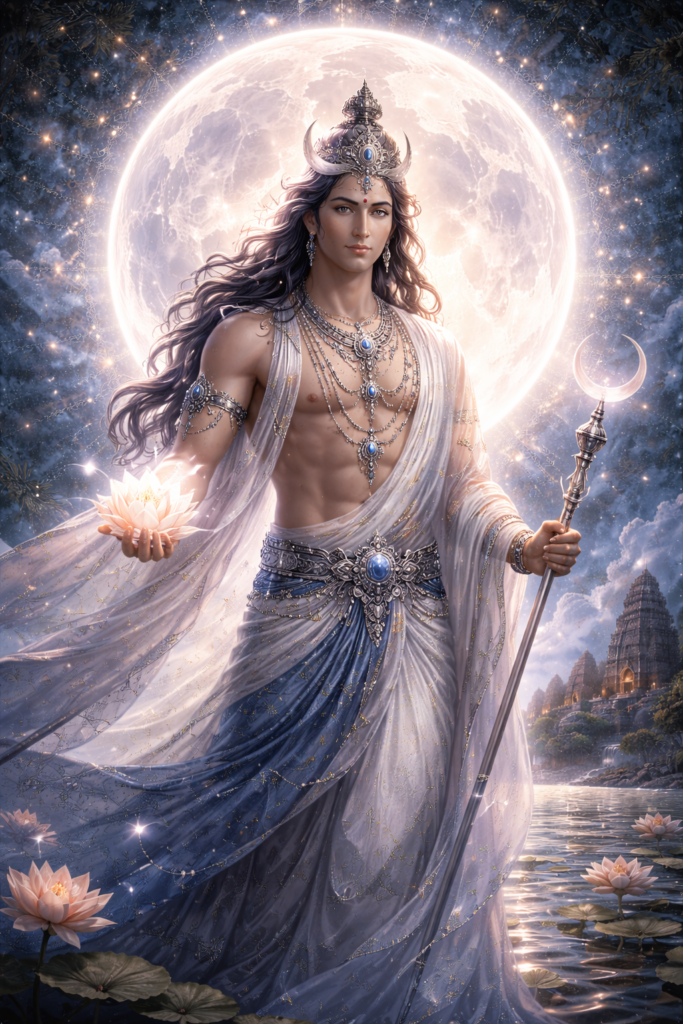
Chandra Deva is not confined to ritual or astrology. He is the measurer of time, the ruler of the mind, the nourisher of herbs, and the guardian of life’s rhythm.
The Indian worldview does not see nature as lifeless. The Sun is Surya Deva, the wind is Vayu Deva, fire is Agni Deva — and the Moon too is a Deva. A “Deva” is that which gives, illuminates, and sustains. In this sense, the Moon continuously contributes to human life.
1. The Vedic Moon — Soma, the Elixir
The earliest references to the Moon appear in the Vedas as Soma. In the Rigveda, Soma is described as a divine essence — the symbol of vitality, inspiration, and even immortality.
Soma was not merely a ritual drink; it represented elevated consciousness. The Vedic seers were keen observers of nature. They saw how lunar cycles affected tides, plant growth, and even human emotions. Thus, the Moon was understood not just as a body in the sky, but as a symbol of life’s subtle nourishment.
2. The Moon and the Mind — Upanishadic Insight
In Indian philosophy, the Moon is considered the lord of the mind (Manas).
The Chandogya Upanishad symbolically links the Moon with the mind — both are rhythmic, fluctuating, sometimes full, sometimes veiled.
Full Moon represents emotional fullness. New Moon represents introspection. Waxing phase signifies growth. Waning phase signifies withdrawal and reflection.
This is not mere poetry; it reflects deep psychological observation. The sages connected cosmic cycles with inner cycles — this is the science of Sanatan thought.
3. “Chanda Mama” — The Moon as Maternal Uncle
In Indian culture, the Moon is lovingly called “Chanda Mama” (Uncle Moon).
In traditional families, the maternal uncle symbolizes affection and protection. While the Sun represents intensity and authority, the Moon represents tenderness and emotional warmth.
In astrology, the Moon signifies the mother. If the Sun symbolizes the father, the Moon embodies maternal compassion. Thus, culture transformed cosmic energy into relationship — making the Moon family.
4. The Moon and Timekeeping
The Hindu calendar is lunar-based. Tithis (lunar days), fortnights, and months are determined by the Moon’s motion.
Vedic astronomy describes 27 Nakshatras (lunar constellations), symbolically referred to as the Moon’s 27 wives. This reflects a precise division of the sky — evidence of systematic astronomical observation in ancient India.
The Moon was central not only to rituals but to agriculture, festivals, and social life.
5. The Churning of the Ocean
According to the Bhagavata Purana, the Moon emerged during the churning of the cosmic ocean. When Lord Shiva consumed the deadly poison (Halahala), he placed the Moon upon his head to cool its burning intensity.
Shiva as Chandrashekhara (the Moon-crested one) symbolizes that cooling awareness is necessary to balance destructive forces. The Moon here represents mental calmness that tempers chaos.
6. The Curse of Daksha — The Phases of the Moon
Puranic lore tells that the Moon married Daksha’s 27 daughters (the Nakshatras) but favored Rohini. Angered, Daksha cursed him with decline. Upon divine intervention, the curse became partial — hence the Moon waxes and wanes.
This myth beautifully encodes astronomical observation into narrative form.
7. The Moon in Ayurveda
In Ayurveda, the Moon represents cooling, nourishing energy. Full moon rays were believed to strengthen herbs.
Water kept under moonlight — Chandra Jal — symbolizes mental calmness and cooling balance.
8. The Moon in Astrology
In Vedic astrology, the Moon governs emotions, memory, intuition, and psychological stability.
A strong Moon signifies emotional intelligence and sensitivity. Here, astronomy and psychology merge.
9. Did Ancient India Understand the Moon Early?
Many civilizations studied the Moon. However, India developed a highly structured lunar calendar and Nakshatra system in very early periods.
Claiming absolute chronological priority is historically complex, but it is undeniable that Sanatan tradition developed a deeply integrated scientific, cultural, and spiritual understanding of the Moon in ancient times.
10. The Moon — God or Mirror?
The Moon shines in the sky — but its true reflection lies within.
A calm mind is a full moon.
A disturbed mind is a new moon.
The Moon teaches that decline is not destruction; it is preparation for renewal.
11. A Deeper Symbol
If the Sun represents the soul, the Moon represents the mind.
The soul is constant; the mind fluctuates.
The Moon changes every night, yet remains the same. It reminds us that transformation does not negate continuity — change itself follows a sacred rhythm.
Conclusion
Chandra Deva is:
• The measurer of time
• The symbol of the mind
• The nourisher of life
• The guardian of rhythm and balance
• And the gentle “uncle” of Indian imagination
Sanatan tradition did not merely observe the Moon — it understood it, lived with it, and wove it into relationship.
The next time you look at the Moon, do not just see a glowing sphere in the sky.
See the rhythm of your own mind — waxing, waning, yet never losing its light. 🌙